
Boston Consulting Group (BCG) published a fascinating article, "US Higher Education’s Make-or-Break Moment", that goes into great depth diagnosing the problems with HigherEd before veering into general prescriptions.
As a contrarian, I beg to differ.
First off, I have to point out that the BCG article uses more jargon than pretty much anything I've ever read. I actually ran it through ChatGPT, which gave it a Jargon Density Score of 7/10, which is higher than the typical 4-6/10 for consultants. Hilariously, it also offered to create a parody version, which I declined.
Jargon aside, the challenges the authors outline are quite real, and they do a fantastic job of showing just how serious the situation is for universities. The Demographic Cliff, where declining birth rates will lower enrollment, is well documented. Social changes concerning the value of higher education clearly contribute to lower enrollment at the undergraduate and graduate levels, especially by males. And the Trump Administration's aggressive policies to limit research and the enrollment of lucrative, full-tuition foreign students are a drain on revenue.
A private equity approach
Honestly, the BCG article reads like a strategy document a private equity fund would prepare for an acquisition target. Among its recommendations:
1. Aggressively reduce expenses and unload assets like real estate.
Obviously, sound fiscal management is important. Most universities teach accounting, finance, management, and economics, and many conduct research. Every university I've ever worked with diligently reduces costs wherever they can, every single year.
At the same time, almost every university invests with a generational perspective, looking ahead to determine what society will need in 10, 20, or 50 years, then educating future educators and building the infrastructure they'll need for students who may not even be born yet. Which is why almost every single university buys up neighboring properties whenever they become available and why selling real estate doesn't make sense for an institution hemmed in by 100+ year old property lines.
Many universities are also diversifying outside of their main geographies. Arizona State University has a campus 400 miles away in downtown Los Angeles. Northeastern University has campuses in Oakland and London. Other American institutions are expanding to Paris, Berlin, Dubai, Tokyo, Seoul, and elsewhere.
2. Implement AI to improve operational efficiency.
Universities have been at the forefront of AI and machine learning research for years. University students are some of the earliest adopters of generative AI. In many ways, universities are large-scale experiments in AI deployment, and they are closely tracking its impact with a range of studies. University of Massachusetts Amherst conducted a study of classroom AI usage and found the impact to be mixed but promising, pointing to exciting possibilities in raising the value of an education.
But they're also reviewing AI's impact in the business world. According to one MIT Study, "The Gen AI Divide State of AI in Business 2025", 95% of enterprise AI implementations are failing to deliver measurable returns. This wouldn't be surprising for any new technology, but rather underscores an important point: there are no magic wands.
3. Focus on practical, career-driven education at the cost of broad, general education.
This is a variation on an old theme that's even more compelling with the rise of AI. The world is becoming more technical, so we have to become more technical to stay competitive.
Logically, this makes sense. In practice, not so much.
The most important figure in the microprocessor era was Steve Jobs. The most important figure in the mobile era was also Steve Jobs.
Steve was an English major who dropped out of college, famously audited a calligraphy class, and sought enlightenment in India. His vision, aesthetics, and communication skills are legendary, but he couldn't code as well as a modern middle schooler.
There is not yet an equivalent to Steve Jobs in the AI era, but it's likely to be someone who thinks critically about AI tools and their role in society, uses them with exceptional creativity, and communicates powerfully with the rest of us. Which sounds like a liberal arts major.
But it won't be Artificial Intelligence itself. Current AI models appear to be limited in their creative abilities to that of an amateur human. Creativity is all about maximizing Originality and Effectiveness simultaneously, which requires intelligence, insight, daring, and cultural awareness. AI models instead balance Originality and Effectiveness, which puts an upper limit on both.
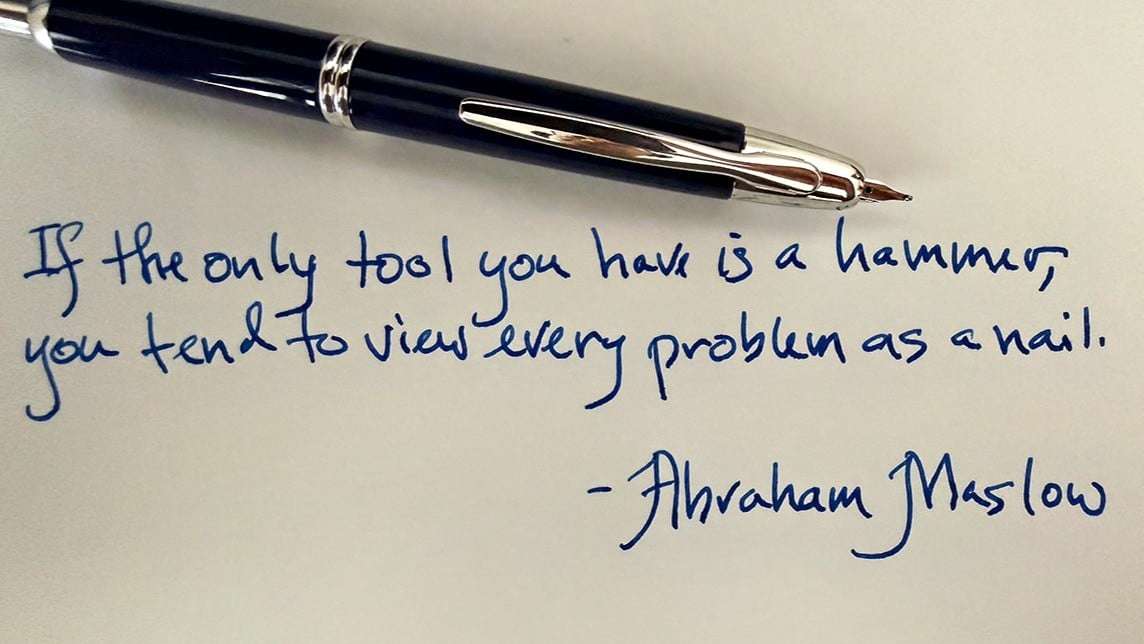
If the only tool you have is a hammer, then you tend to see every problem as a nail.
Ultimately, my biggest problem with the BCG article is how it treats higher education as a transaction to be optimized.
It isn't. It's a relationship that must be optimized.
To be fair, I own a boutique ad agency that focuses on relationships and not a prestigious management consultancy that serves the Fortune 500. My toolbox is tiny compared to BCG. I tend to look for nails to hammer.
Education is important, but so is the institution.
Q: How can you tell if someone went to Harvard?
A: They'll tell you.
— Told to me by a Harvard alum
The undergraduate decisions we make as teenagers and the graduate decisions soon after follow us for the rest of our lives, defining how we think of ourselves and how others perceive us.
Universities understand this, of course, which is why they invest so heavily in athletics and branded merchandise to feed the identity of students, alumni, and parents. Unfortunately, most stop at this point and turn transactional, trying to turn their alumni into ATM machines.
In my work of helping universities to optimize relationships, I can't tell you how many variations I've heard of "I graduated from XYZ so many years ago and you're the first person who's reached out to me and didn't ask for a donation."
Optimizing relationships with alumni
Most universities have no clue who their alumni are beyond basic demographics and donation history. They're missing out on so much non-monetary value:
- Alumni have a wide range of unique and varied skills and remarkable stories. Students from my alma mater regularly reach out for advice and insights, and I'm happy to help. But I've never been approached by the administration for advice or insights, even though I'm regularly asked for donations.
- Alumni hire graduates and pay for their continuing education. We also have kids, and while preferential legacy admissions is justifiably controversial, I'm also not aware of any of my classmates whose kids followed in their footsteps. Mine aren't.
- Alumni have connections who can make amazing things happen. Over the course of my career, I've met astronauts, generals, billionaires, star athletes, legendary musicians, entrepreneurs, politicians, film directors, writers, producers, CEOs, gurus, poets, and countless others who are far more accomplished than I'll ever be. As a network, the value is immense, far more than me personally.

Optimizing relationships with industry
A limiting factor for companies in the 21st century is the education of their employees, and AI is actually making this worse and not better.
At a time when AI is wrong 52% of the time in answers to programming questions, uneducated employees exacerbate problems, while educated employees enhance abilities.
The key to AI is thinking critically and creatively about all inputs and outputs. Critical and creative thinking are higher-order skills built into the DNA of university curricula, but conspicuously absent from AI.

But relationships are not just one-way. Enterprises have specific and evolving needs that can only be addressed when educators are in an ongoing conversation with senior executives and frontline employees. Many of the most innovative new programs emerging from higher ed were developed to meet the needs of specific employers and later converted to mass-market programs.
Optimizing relationships with governments
Every university maintains close ties with state and local governments, given their need for funding, permits, land, utilities, roads, law enforcement, etc., as well as the thousands of jobs they create and taxes they pay, the businesses they support, and the prestige they bring. It's simply impossible to maintain any sort of scale, even for private institutions, without close cooperation with all levels of government. The more levels at which relationships are fostered, the better the outcome for both.
But what about non-local governments? In an era where professional sports teams garner millions in public financing, why can't universities do the same?
More exciting, what's limiting universities from branching out beyond their own country? American higher education is so valued worldwide that international families routinely pay a premium to send their children stateside. A university with a strong relationship with these families and their governments opens up the possibility of international expansion that simultaneously attracts more students, buffers against political changes, and enhances the value of existing programs.
While many universities already have programs in London, Paris, Berlin, Tokyo, Beijing, and other big, expensive cities, a 50 or 100-year timeline would point toward the Southern Hemisphere and developing areas. These are not only places that could massively benefit from the science, engineering, healthcare, agriculture, financial, and legal instruction that these programs could bring, but also contribute creativity and energy, and entirely new solutions of their own.
Taking the lead on the uphill
At the end of the day, in these difficult, turbulent times, universities have two main choices: they can narrow their focus and their scale and follow conventional wisdom, or they can lean into their unparalleled branding, creativity, academic prowess, and networks to do the extraordinary.
Tough times don't last, and the winners are the ones who take the lead on the uphill.
If this resonates for you, I'd love to discuss further.